Chandler is proposing another utility-rate adjustment that would take effect January 4, 2027, if approved. Replacing irrigated grass with an appropriate low-water design can reduce outdoor water demand. Artificial turf needs no routine irrigation to grow, but occasional rinsing, cooling, and irrigation for living plants can still use water. Your utility bill will not disappear.
What Chandler Is Proposing for January 2027
Chandler’s official 2027 utility-rate notice describes proposed changes for water, wastewater, reclaimed water, and solid waste. The proposed effective date is January 4, 2027. As of this article’s publication, the proposal should not be described as an adopted increase.
The city’s notice identifies an October 15, 2026 public hearing. Check the current notice and council actions before relying on a final implementation schedule. Meter size, water usage, and service mix affect each household differently; the city’s bill calculator is more useful than applying a headline percentage to your entire bill.
For homeowners considering artificial turf in Chandler, this is a good time to review irrigation use and design options. It is not a reason to skip HOA approval, drainage planning, or a careful comparison of installation quotes.
The East Valley Picture
Water costs are a planning issue beyond Chandler. Each municipality has its own rate schedule, infrastructure needs, conservation incentives, and approval process. A rate change in one city does not automatically apply to a neighboring address.
Queen Creek: The town is proposing a usage-based water-resource fee to support long-term supply and infrastructure. Its published year-one proposal is $3.07 per 1,000 gallons, with applicable credits affecting some accounts. A November 18, 2026 hearing and possible action are scheduled, with the earliest applicable date in January 2027 and the first bills with the fee in March. Use the town’s information and calculator to assess your account rather than assuming every household pays the same amount.
Gilbert and Scottsdale: Review your utility’s current rate schedule alongside its conservation program. Compare your actual summer and winter consumption, not another homeowner’s total bill. The water portion, wastewater portion, fixed charges, and taxes may respond differently when irrigation is reduced.
Mesa, Tempe, and Phoenix: The same approach applies. Check your provider and current usage tiers before estimating savings. An HOA’s shared landscape meter is separate from your household account, so common-area improvements need their own analysis.
Why Rates Keep Moving
Chandler cites higher operating expenses and capital costs, including treatment chemicals, electricity, aging water infrastructure, and related debt service. Replacing pipes and maintaining treatment facilities affect the cost of delivering water even before a homeowner turns on an irrigation valve.
Long-term supply planning also matters throughout the Valley. Queen Creek’s proposed resource fee illustrates how securing additional water can become part of the household budget. Future Colorado River operating decisions add uncertainty; do not treat a forecast of cuts as a finalized allocation or an exact prediction of your bill.
What This Means for a Living Lawn
A lawn’s water demand depends on its area, grass type, weather, irrigation efficiency, and maintenance. Start with twelve months of water bills and an irrigation inspection. Repair leaks and overspray before deciding how much of the yard to convert.
A practical design can reserve artificial turf for usable play or lounge areas, retain living shade trees, and use desert-adapted planting or rock in other zones. Capping an unused lawn-irrigation branch does not mean abandoning the water that trees and shrubs still need.
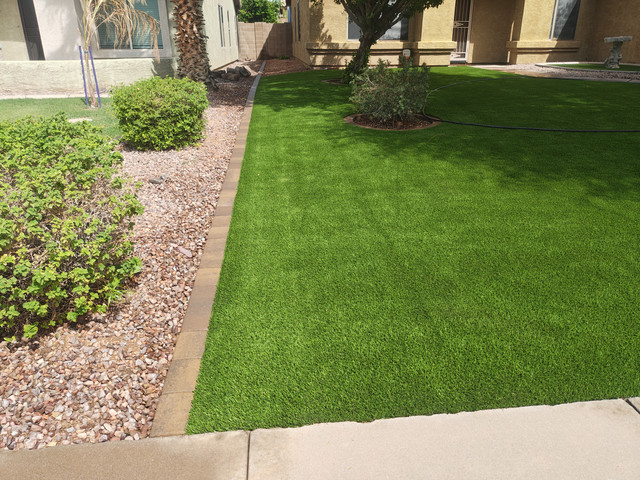
Synthetic turf can become hot in direct Arizona sun. Plan shade and check surface temperatures before children or pets use it. Cleaning, especially in pet areas, remains part of maintenance. Explore our pet-turf options and installation process before choosing a product.
City Rebates: Read the Rules Before Removing Grass
Grass-removal incentives are not universal artificial-turf rebates. Obtain the applicable city’s written approval before demolition and confirm current funding, eligible materials, inspection requirements, and completion deadlines.
Chandler: The current residential policy offers $1.50 per square foot of qualifying grass removal, up to $2,000 per property. It requires an approved low-water landscape and a Notice to Proceed. Areas converted to artificial turf do not qualify. Plant coverage and other eligibility conditions also apply. Read the official Chandler rebate policy before budgeting an incentive.
Other Valley cities: Gilbert, Scottsdale, Mesa, and Phoenix have different programs and rules. Ask the relevant conservation office whether artificial turf is permitted, whether limits apply, and whether the proposed layout meets planting requirements. Do not assume a program from a previous year or another city covers your project.
Working With Your HOA
Get the community’s written landscape guidelines before selecting materials. An architectural review may require a site plan, product specifications, a sample, and drainage or edge details. Requirements can differ for front yards, backyards visible from common areas, and association-maintained spaces.
Build review time into the schedule and obtain written approval before demolition. Our HOA turf planning guide explains the information commonly included in a submission. Approval remains the association’s decision.
The Landscape Budget
Always Green Turf serves Chandler and the East Valley with artificial grass and coordinated landscape improvements. A site-specific quote should identify demolition, access, grading, drainage, base preparation, turf, infill, edging, irrigation changes, and cleanup. Ask for the applicable product and workmanship warranties in writing.
Installation cost and water savings vary too much to promise one payback period. Estimate avoided irrigation gallons using your own records, apply your utility’s applicable usage rates, and account for remaining fixed charges, plant irrigation, and cleaning. Include maintenance and eventual replacement when comparing a living lawn with synthetic turf.
For example, avoiding 5,000 gallons at an illustrative usage charge of $4 per 1,000 gallons saves $20 for that billing period—not the entire utility bill. This is a calculation example, not a Chandler rate quote or a savings guarantee.
What to Do Next
- Review your current utility schedule and twelve months of usage.
- Measure the grass area and inspect the irrigation system.
- Confirm rebate eligibility and HOA requirements before demolition.
- Plan shade, living plants, drainage, and access together.
- Compare written installation scopes and realistic operating costs.
Call (480) 530-5476 or book a Free Design Consultation to discuss your yard. A measured design can help you decide where turf, pavers, planting, or landscape rock makes sense.
Official Sources and Updates
Reviewed September 30, 2026. Rates and incentive rules can change. Confirm the current terms directly with your utility before committing to a project.