Drought-resistant landscaping in Arizona means designing a yard that stays attractive on little or no supplemental irrigation. The three main approaches are xeriscape planting, decomposed granite and gravel, and artificial turf — and most successful yards use a combination. Outdoor irrigation is typically the largest share of residential water use, so reducing it is the fastest way to cut a water bill that keeps climbing.
Why Arizona Yards Are Changing
Two pressures are pushing Arizona homeowners toward low-water landscaping at the same time.
The first is supply. Reduced Colorado River allocations and long-term drought planning have made water a live policy question across the state, and municipal utilities have been adjusting rates and conservation programmes in response.
The second is cost. Water rate increases have landed in city after city, and because outdoor irrigation is usually the biggest single category of household consumption, a rate increase hits yards hardest. A lawn that was affordable to keep green a decade ago is a different proposition now. We tracked the specifics in our Arizona water rates guide.
The result is that "drought-resistant" has stopped being an environmental preference and started being an ordinary financial decision.
What Drought-Resistant Actually Means
The term gets used loosely. Three distinctions are worth keeping straight, because they lead to different yards:
- Drought-tolerant describes plants that survive dry spells once established, but still want occasional water.
- Drought-resistant describes a landscape designed to need little or no supplemental irrigation at all.
- Xeriscape is a design method — grouping plants by water need, improving soil, mulching, and irrigating efficiently — not a specific look. Xeriscape does not mean rocks.
That last point matters, because the most common regret we hear is from homeowners who converted a lawn to wall-to-wall gravel, cut their water bill, and then found they had a yard nobody wanted to be in.
Low-Water Landscaping Ideas That Still Look Like a Yard
- Keep a usable green zone, shrink the irrigated one. Most families need somewhere to sit, play, or let a dog out. Meeting that need with artificial turf removes the irrigation while keeping the function.
- Group plants by water need. The core xeriscape principle. Thirsty plants clustered near the patio, natives on the perimeter, nothing irrigated that doesn't need it.
- Choose Sonoran natives. Desert spoon, brittlebush, agave, red yucca, and native shrubs hold their shape through summer without a drip line running daily.
- Use shade as infrastructure. A well-placed tree or ramada reduces evaporation across everything under it, which cuts the water need of the plants that remain.
- Mulch every planted bed. Bare soil in Arizona loses moisture fast. Mulch is one of the cheapest water savings available.
- Fix the irrigation you keep. Drip beats spray in this climate by a wide margin, and a controller that isn't watering on a schedule from three seasons ago saves more than most people expect.
- Design for monsoon runoff. Directing the rain you do get into planted areas rather than the street is free irrigation several times a year.
Xeriscape, Gravel, or Artificial Turf?
Each solves a different problem, and the honest answer is that none of them is right for a whole yard.
Xeriscape planting gives you living texture, seasonal change, and habitat, on far less water than a lawn. It costs the least to install per square foot in most cases. It does require some ongoing maintenance and some irrigation, and it doesn't give you a surface children or dogs can use.
Decomposed granite and gravel use no water at all and cost little. They also radiate heat, can be uncomfortable underfoot, offer nothing to look at, and tend to collect weeds and debris over time. Used as ground cover between planted areas they work well. Used across an entire yard they are the reason "zero-scape" became a criticism.
Artificial turf eliminates irrigation on the part of the yard people actually use. It stays green year-round, handles pets and play, and needs no mowing or fertiliser. It costs more up front than either alternative, and it does get warmer than natural grass in direct sun — which is worth planning around rather than ignoring.
The Combination Most Yards Land On
In practice, the yards that work in Phoenix metro tend to use all three deliberately: artificial turf where people and pets spend time, native and drought-tolerant planting for structure and interest around it, and granite or gravel as the connective ground cover between them, with shade over as much of it as possible.
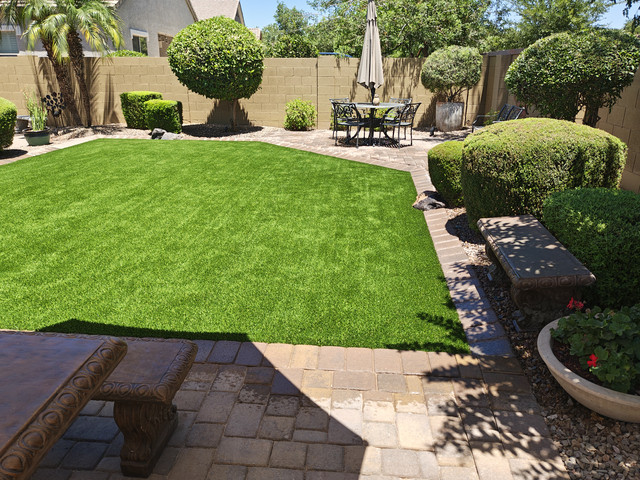
That layout removes nearly all outdoor irrigation while keeping a yard that reads as a garden rather than a parking lot. Our Arizona backyard design ideas and pavers and grass combinations show how the pieces fit together.
What It Costs and What It Saves
Costs vary with yard size, access, demolition, and grading, but the general shape is consistent: gravel is cheapest to install, xeriscape planting sits in the middle, and artificial turf is highest up front and lowest thereafter.
The savings side depends almost entirely on how much irrigated area you remove and what your utility charges. Because outdoor watering is usually the largest single share of a household's use, and because Arizona rates have been rising rather than holding, the payback period on removing irrigation has been shortening rather than lengthening. Our water savings breakdown works through the arithmetic.
It's also worth checking your city's conservation programmes before you start — several Arizona municipalities have offered turf-conversion or landscape rebates, and terms change year to year.
Frequently Asked Questions
Does drought-resistant landscaping have to look like a rock yard?
No. That's a design choice, not a requirement. Xeriscape is a method for grouping and irrigating plants efficiently — it says nothing about using gravel as ground cover everywhere.
Will low-water landscaping hurt my home's value?
A well-designed low-water yard is generally an asset in Arizona, where buyers understand the water context. A neglected gravel expanse is not. The design matters more than the category.
Can I keep some real grass?
Yes, and many homeowners do. Shrinking the irrigated lawn to a deliberate, small area rather than eliminating it captures most of the saving.
How much water does artificial turf actually save?
It removes irrigation on the area it covers entirely. The saving in dollars depends on your yard size and your utility's rate structure.
Do drought-resistant yards need less maintenance?
Usually, but not none. Native plantings need periodic pruning, gravel needs weeding and refreshing, and turf needs rinsing and brushing. All are lighter than mowing and fertilising a lawn.